
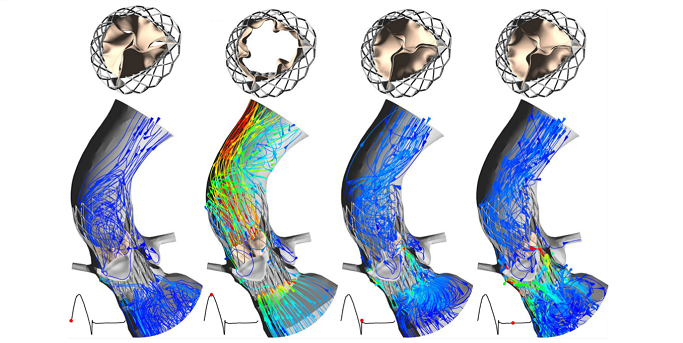
Transcatheter aortic valve replacement (TAVR) is a minimally invasive procedure that provides an effective alternative to open-heart surgical valve replacement for treating advanced calcific aortic valve disease patients.
However, complications, such as valve durability, device migration, paravalvular leakage (PVL), and thrombogenicity may lead to increased overall post-TAVR morbidity and mortality. A series of numerical studies involving a self-expandable TAVR valve were performed to evaluate these complications. Structural studies were performed with finite element (FE) analysis, followed by computational fluid dynamics (CFD) simulations, and fluid–structure interaction (FSI) analysis.
The FE analysis was utilized to study the effect of TAVR valve implantation depth on valve anchorage in the Living Heart Human Model, which is capable of simulating beating heart during repeated cardiac cycles. The TAVR deployment cases where no valve migration was observed were then used to calculate the post-deployment thrombogenic potential via CFD simulations. FSI analysis followed to further assess the post-deployment TAVR hemodynamic performance for different implantation depths.
The deployed valves PVL, geometric and effective orifice areas, and the leaflets structural and flow stress magnitudes were compared to determine the device optimal landing zone. The combined structural and hemodynamic analysis indicated that with the TAVR valve deployed at an aft ventricle position an optimal performance was achieved in the specific anatomy studied.
Given the TAVR’s rapid expansion to younger lower-risk patients, the comprehensive numerical methodology proposed here can potentially be used as a predictive tool for both procedural planning and valve design optimization to minimize the reported complications.
Ghosh R.P., Marom G., Bianchi M., D’souza K., Zietak W., Bluestein D. - "Numerical evaluation of transcatheter aortic valve performance during heart beating and its post-deployment fluid–structure interaction analysis".