
Transcatheter Aortic Valve Replacement (TAVR) has emerged as a Transcatheter Aortic Valve Replacement (TAVR) has emerged as a life-saving solution for inoperable elderly patients with calcific aortic valve(CAV) disease, often as their only life-saving treatment. However, failed delivery due to tortuous aortic geometry, valve migration, and paravalvular leaks (PVL) lead to increased stroke risk, increasing the overall morbidity and mortality post-TAVR.
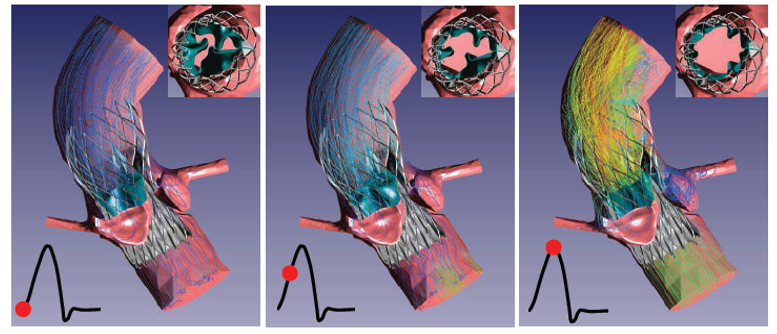
There are numerical studies that attempted to address these complications, but the focus was only on the TAVR valves deployment, thus neglecting their post-deployment performances during heart beating. We hereby present first of its kind simulation that studies TAVR valve deployment in Simulia Living HeartHuman Model (LHHM), which is capable of simulating beating heart for repeated cardiac cycles. The aims of this study are to examine the TAVRvalve anchorage, PVL, hemodynamics, and the thrombogenic potential during heartbeat via LHHM.
Ram P. Ghosh1, Matteo Bianchi1, Gil Marom2, Praveen Sridhar3, Karl D'souza4, Wojtek Zietak5, Danny Bluestein1
1Stony Brook University, USA, 2Tel Aviv University, Israel; 3Dassault Systemès, Simulia, Germany; 4Dassault Systemès, Simulia, USA; 5Capvidia, Belgium