
Prosthetic heart valves deployed in the left heart (aortic and mitral) are subjected to harsh hemodynamical conditions. Most of the tissue engineered heart valves have been developed for the low-pressure pulmonary position because of the difficulties in fabricating a mechanically strong valve, able to withstand the systemic circulation. This necessitates the use of reinforcing scaffolds, resulting in a tissue-engineered textile reinforced tubular aortic heart valve.
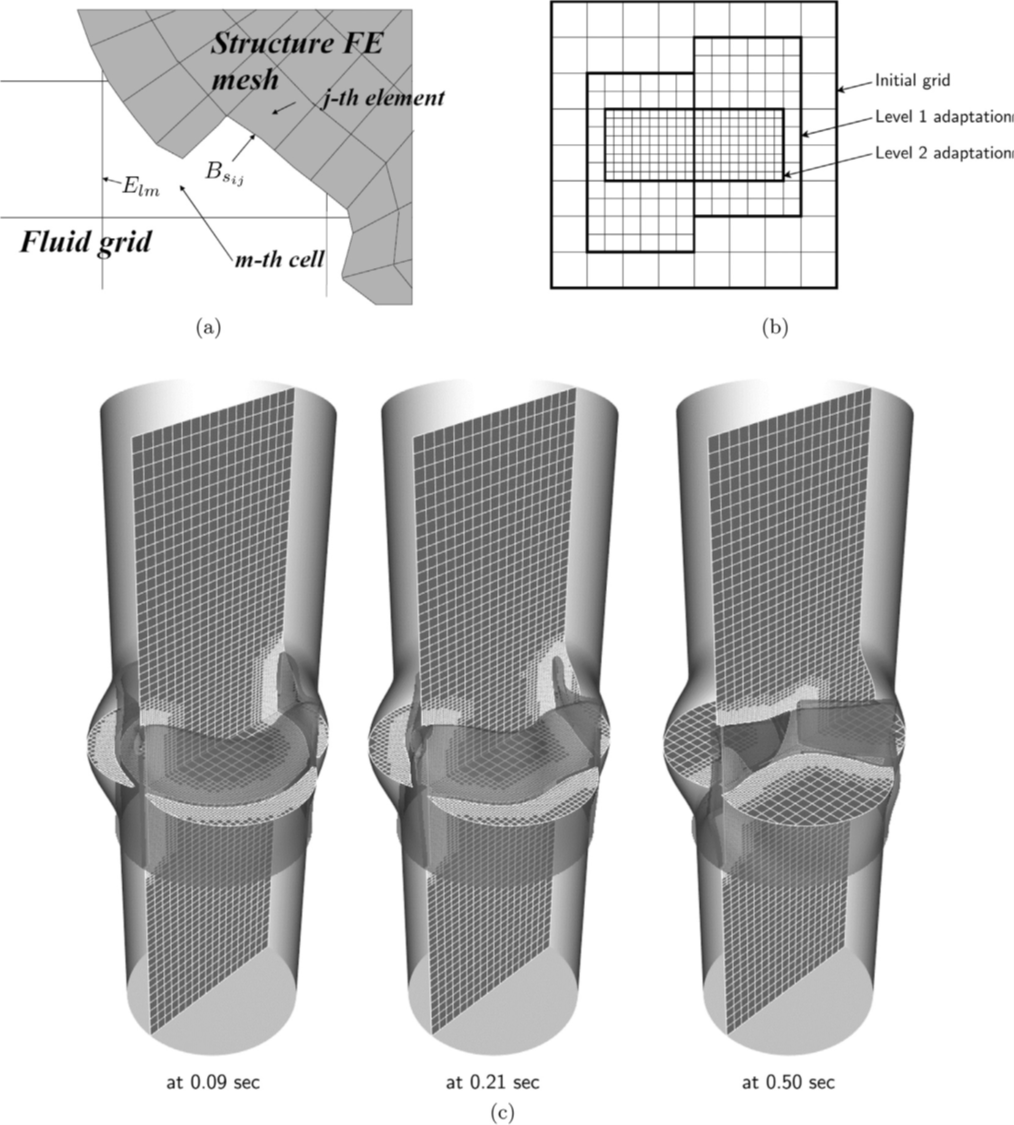
Therefore, to better design, these implants, material behavior of the composite, valve kinematics and its hemodynamical response need to be evaluated. Experimental assessment can be immensely time consuming and expensive, paving way for numerical studies. In this work, the material properties obtained using the previously proposed multi-scale numerical method for textile composites was evaluated for its accuracy. An in silico immersed boundary (IB) fluid-structure interaction (FSI) simulation emulating the in vitro experiment was set-up to evaluate and compare the geometric orifice area and flow rate for one beat cycle. Results from the in silico FSI simulation were found to be in good coherence with the in vitro test during the systolic phase, while the mean deviation of approximately 9% was observed during the diastolic phase of a beat cycle. Merits and demerits of the in the silico IB-FSI method for the presented case study has been discussed with the advantages outweighing the drawbacks, indicating the potential towards an effective use of this framework in the development and analysis of heart valves.
Deepanshu Sodhani, Stefanie Reese, Andrey Aksenov, Sinan Soğancı, Stefan Jockenhövel, Petra Mela, Scott Edward Stapleton
RWTH Aachen University, TESIS, Capvidia, University of Massachusetts Lowell