Simulating human body and medical devices with FlowVision CFD and FlowVision + Abaqus FSI
The heart is a hard thing to simulate. The muscle contracts, electrical signals set off that contraction, blood moves through it and forms vortices, and the valves open and close under pressure. FlowVision CFD, together with Abaqus, was built to handle this mix of physics, so that device makers, researchers, and clinicians can design, test, and diagnose in silico.
FlowVision has worked with Abaqus on strongly coupled fluid structure interaction (FSI) since 2002. FlowVision solves the blood flow as the CFD engine, and Abaqus solves the structure as the FEA engine.
FlowVision CFD
FlowVision is an all in one CFD package. It includes the Pre/Post-Processor, the solver modules, and configurators for HPC environments. It uses the finite volume method to approximate the equations of fluid motion, with high order approximation and low phase errors.
At the center of the cardiac work is the SGGR™ method, short for Sub-Grid Geometry Resolution. It works straight from the original CAD and FE geometry, with no simplification, de-featuring, or approximation. It does this by trimming the parametric Cartesian grid to the exact CAD/FE boundaries. Because it links the CFD and FEA meshes directly, the transfer between them stays conservative and error free.
For blood flow, FlowVision handles multi-channel and multiscale flow, models blood as both Newtonian and non-Newtonian, and evaluates blood damage. You can view the results as velocity vectors, streamlines, and wall shear stress (WSS), which show where the flow is fast or slow and where the risk of clotting is high.
FlowVision + Abaqus FSI
Abaqus and FlowVision together give you production proven, two way FSI for real problems. The SGGR™ true geometry meshing uses the native CAD/FE surfaces in the flow solver, and those same surfaces carry a stable, conservative load exchange.
For valves, the important capability is trick-free full contact. New generation all-Mach number solvers, SGGR cells, and gap modeling work together to let solid objects touch or even overlap inside the flow simulation. That way, full contact and closure, such as leaflets meeting, is captured directly. The Gap Model handles this on its own. When two solid parts come close and pass the proximity threshold, it switches on and keeps the study inside a practical run time.
There is more than one way to bring motion into the CFD. The gold standard is 2-way coupling, either explicit or implicit. FlowVision also offers 1-way coupling, in both synchronous and asynchronous forms, along with hardcoded geometry replacement and rigid motion under fluid load. Adaptive parametric grids and gap modeling take care of leaks and thin gaps, so teams can move from concept to verification against in-vitro and in-vivo data with a faster setup and reliable convergence.
Applications
- Heart valves and TAVR/TAVI. Two way FSI simulation of transcatheter aortic valve replacement devices. This includes how the deployment location, annular or supra-annular, changes the flow in the ascending aorta and coronary arteries, and how the leaflets move.
- Mitral valve therapies. Mitral valve and Mitral Clip simulation, edge to edge (Alfieri) repair, and annuloplasty ring optimization for functional mitral regurgitation.
- Vascular devices. Meshing and analysis of vascular devices, stent placement, and coronary artery stenosis.
- Non-invasive diagnosis. Patient specific modeling to produce virtual angiograms and Fractional Flow Reserve (FFR) indexing, so coronary artery disease can be checked without an invasive procedure.
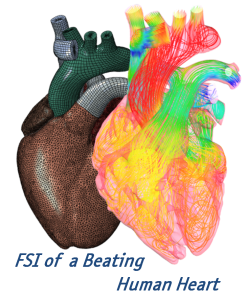
- Whole heart modeling. Simulations built on the Living Heart Human Model (LHHM) to show beating motion and valve performance. These combine one way FSI for the heart muscle movement with two way strongly coupled FSI for the device accuracy. Read more about LHP
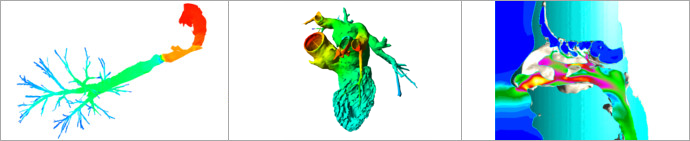
Beyond the heart, the same FlowVision approach carries over to other parts of the body where fluid meets moving or delicate tissue. The physics is the same story told in a new setting: air or fluid flowing past surfaces that bend, open, or hold a fine clearance, which is exactly what SGGR™ true geometry meshing and FlowVision + Abaqus FSI are built to handle. These application areas include:
- Lung FSI simulation
- Eye cataract removal simulation
- Contact lens dynamic deformation and stability optimization with FSI
- Spray distribution along the nasal cavities
FlowVision lets you test and improve a design in silico where in vivo and in vitro testing comes up short. The fluid and solid domains match exactly, the loads and deformations stay accurate, the manual coupling work goes away, and it all runs at a reasonable cost.
Let's talk. connect@medividia.com