
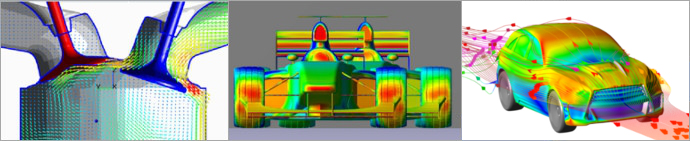
FlowVision for the Automotive Industry
FlowVision is a general purpose computational fluid dynamics package developed for the fluid, thermal, and multiphysics problems encountered throughout vehicle development. It imports complex CAD assemblies directly, generates its computational mesh automatically, and couples with external solvers when structural analysis or optimization must be added to a flow simulation. The result is a single environment in which engineers can study engines, rotating machinery, climate systems, aerodynamics, and tire behavior without transferring geometry between disconnected tools.
Application areas
FlowVision is applied across the full range of automotive systems. The sections below summarize the principal areas covered in the source material.
Engine and powertrain. FlowVision addresses the internal working processes of the engine, from combustion to lubrication. Because computational cells retain their cubic shape, gas mixing in the cylinder is calculated with high accuracy, and because moving bodies are permitted to intersect walls, leakage through closed valve gaps is fully excluded.
-
Combustion and mixing, including homogeneous combustion with plasma discharge ignition
-
Cooling and heat exchangers
-
Fuel supply, including high pressure injection and spray breakup
-
Thermally loaded condition of internal combustion engine parts, such as exhaust manifolds, with temperature fields transferred to Abaqus for stress analysis
-
Lubrication, boost, and recuperation, including dynamic boost
Rotating machinery. The gap model allows thin clearances to be represented accurately without resolving them in the mesh, which makes FlowVision well suited to compressors, turbines, and related equipment.
-
Turbines, compressors, pneumatic starters, and flow meters
-
Screw compressors, where the gap model delivers accurate results with minimal computational resources
-
Rotary vane compressors and vortex turbines
-
Improvement of flow uniformity in turbines through correction of the nozzle vane profile
Machine parts and fluids in motion. FlowVision models the movement of oil and fuel within components that are themselves in motion, and it couples with finite element packages where deformation of the surrounding parts must be considered.
-
Rubber seals and oil scraper caps, modeled together with Abaqus
-
Transmission and oil sump lubrication, including assessment of gear lubrication
-
Movement of fuel and oil in moving tanks and sumps, using the VOF method with a mass conservation error below 5 percent
Ventilation and climate control. The package evaluates thermal comfort and air quality in enclosed spaces, taking account of heat and moisture sources as well as the position of air deflectors.
-
Humidity, heating, cooling, and ventilation in cabins, bodies, interiors, and production areas
-
Air conditioning and ventilation in production facilities
-
Calculation of contaminant concentration in the air
External aerodynamics. FlowVision computes vehicle drag under realistic conditions and supports the study of cooling flows and aerodynamic noise.
-
Aerodynamic drag, including rotating wheels, radiator resistance, and underhood cavities
-
Effects of wind and adjacent traffic, such as vehicle convoys and trains
-
Wipers, mud flaps, and soiling of mirrors and glazing
-
Cooling of braking systems, electric motors, and generators
-
Brake disc ventilation
-
Acoustics, analyzed either in the near field through pressure oscillation or in the far field by transferring the pressure field to LMS Virtual.Lab Acoustic
Tire industry. FlowVision supports both the manufacturing of rubber products and the analysis of tire performance in service. Hydroplaning is modeled together with tire deformation, and the numerical results have been confirmed by full scale testing, which reduces the need for test track rental.
-
Rubber mixing, extrusion, casting, and molding
-
Hydroplaning, modeled with tire deformation and validated against full scale testing
-
Tire acoustics in the near and far field
Multiphysics in a single environment
FlowVision resolves a wide range of physical processes within one solver. It handles Newtonian and non Newtonian fluids, compressible and incompressible flow at subsonic and supersonic speeds within the same computational domain, conjugate heat transfer and radiation, electro magneto hydrodynamics, multistage chemical reactions and combustion, mixing of multicomponent fluids, free surface flows with the VOF method, and particle modeling for solid, liquid, and gaseous phases with evaporation, combustion, coalescence, and breakup.
Why engineers choose FlowVision
Beyond the breadth of physics it covers, FlowVision is designed to reduce the preparation effort that often dominates a simulation project.
-
Work with complex geometry as supplied. Highly detailed models and full assemblies can be imported without prior simplification. FlowVision supports a broad set of CAD and mesh formats, including STEP, IGES, Parasolid, CATIA V4, V5, and V6, Creo, SolidWorks, Solid Edge, NX, Inventor, STL, NASTRAN, Abaqus (INP), and Ansys (CDB), among others.
-
Automatic meshing for difficult surfaces. The solver constructs an orthogonal mesh with local refinement and subgrid resolution automatically, which removes the need for days of manual meshing on complex surfaces.
-
Accurate treatment of thin clearances. The gap model resolves very thin gaps between surfaces without meshing them directly, conserving computational resources.
-
Moving bodies without mesh deformation. Complex wall motion is modeled while the mesh retains its shape, which supports the accuracy of the solution.
-
Coupling with third party packages. Integration with external tools allows optimization problems and the deformation of solids under aerodynamic and hydraulic loads to be solved.
-
Formula editor and material database. Complex relationships for user variables can be defined, supported by a built in substance database.
-
Parallel solver tested on high capacity hardware. The parallel solver is tested on some of the most powerful supercomputers in the country.
-
Accuracy proven in demanding fields. FlowVision is certified for the design of nuclear power plants, and its accuracy has been verified against full scale testing in several applications.
Let's talk. connect@medividia.com
